
- Posted on
- • Uncategorized
AI NPCs Could Make Game Worlds Feel Alive Again
- Author
-
-

- User
- fpgamer-admin
- Posts by this author
- Posts by this author
-
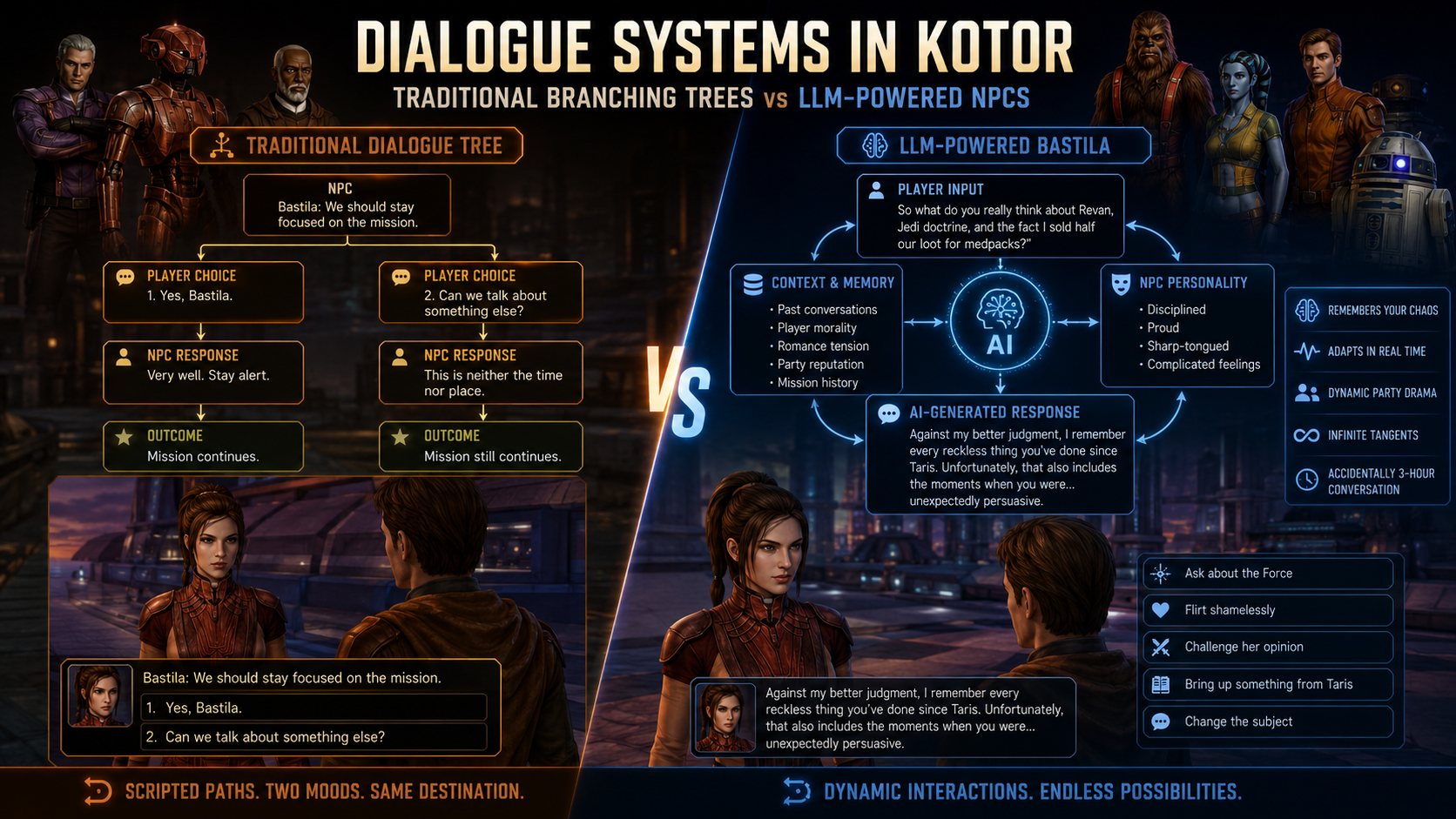
On one side, you have the traditional RPG dialogue tree. The NPC says something. The player picks from two or three responses. The NPC gives a written reply. The mission continues. If the writing is good, that can still be great. Some of the best games ever made were built on exactly that system.
But it is still a system of rails.
The other side of the image imagines something different. A version of Bastila from Knights of the Old Republic with memory, personality, party history, player reputation, and context. Not a real mod. Not something I played. Just a visual example of where this could go.
Instead of asking the player to choose from a tiny menu of approved responses, the game could let the player actually speak. The NPC could remember what happened earlier. She could react to your choices, your tone, your past mistakes, your romance path, your reputation, and the chaos you have been dragging through the galaxy.
That is the promise of AI powered NPCs.
Not endless random chatter. Not replacing good writing with a chatbot in a robe. The exciting version is a game where the characters have enough memory and flexibility to respond to the player as if the world has actually been paying attention.
That is the part I think people are missing.
Most of the conversation around AI in games gets flattened into fear almost immediately. People hear AI and picture bad writing, stolen art, broken voice lines, or some publisher trying to use software as an excuse to fire human beings. I understand why people go there. The industry has not exactly earned unlimited trust on that front.
But AI NPCs are a different conversation when you stop treating them as a replacement for writers and start treating them as a new layer of interaction.
A writer still creates the character. A designer still defines the role that character plays in the world. A narrative team still decides what matters, what should never happen, and what the emotional boundaries are. The AI layer should not be the author of the game. It should be the part that lets the character respond inside the space the authors created.
That is a big difference.
Ubisoft has been one of the more visible companies pushing in this direction. Its Neo NPC project was shown as a generative AI prototype built around the idea of more natural player interaction. The point was not just to make NPCs talk more. The goal was to see if a player could interact with a character without breaking the authenticity of the situation or the personality of the NPC.
That phrase matters. Authenticity is the whole ballgame.
A bad AI NPC would be worse than a silent one. Nobody wants a fantasy guard suddenly talking like a Reddit comment section. Nobody wants a resistance leader in a serious shooter drifting into customer service voice. Nobody wants an RPG companion forgetting the last ten hours of story and confidently making up nonsense.
That is the fear, and it is a fair one.
But the optimistic version is powerful enough that I do not think we should dismiss it just because the first wave is going to be awkward.
Think about what this could mean in an open world game.
Right now, most open worlds are impressive until you notice how little they remember. You clear a camp, finish a mission, insult a faction, rescue someone, betray someone else, and the world mostly resets around you. NPCs may bark different lines. A quest giver may mention your reputation. A town may swap out a few flags or guards. But the social layer of the world is usually paper thin.
The dream version of AI NPCs is not that every villager becomes a podcast guest.
The dream is that the world starts reacting with a little more continuity.
A guard might remember that you spared him earlier. A hostile patrol might know you talked your way through another checkpoint. A friendly NPC might trust you because of something you said in a previous mission. A companion might call you out because your actions do not match the kind of person you keep claiming to be.
That is not just better dialogue.
That is memory as gameplay.
This is where a series like Far Cry becomes an obvious thought experiment. Far Cry has always been built around outposts, factions, improvisation, weapons, vehicles, predators, villains, and chaos. It is already a series about walking into a situation and deciding whether to sneak, talk, sabotage, shoot, burn, or run.
Now imagine if conversation became part of that same tool set.
Not instead of combat. Alongside it.
You roll up to an outpost. Maybe you can threaten a guard because your reputation is already terrifying. Maybe you can talk your way inside because you helped someone from that faction earlier. Maybe one enemy recognizes you and panics. Maybe another tries to stall while calling backup. Maybe a captive lies to you because they remember you abandoned their village three missions ago.
That is the kind of thing that could make a familiar open world formula feel new again.
Of course, that is the dream version. The current rumor around Far Cry 7 is much messier. Recent reporting has claimed that Ubisoft has been using an early version of Far Cry 7 as a research and development testbed for generative AI. That does not mean Far Cry 7 will ship with AI NPCs. It does not mean the feature is confirmed. It does not mean players will be talking to every guard through a microphone on launch day.
It means the idea is being tested.
And apparently, if the rumor is accurate, it is very early.
That should not surprise anyone. Early versions of new game systems usually look terrible. Early physics systems looked broken. Early open worlds were empty. Early voice acting was awkward. Early online multiplayer was a miracle when it worked at all. The first version of a future standard rarely looks like the future. It usually looks like a bad idea that refuses to die.
That is why I am less interested in whether the earliest tests look polished and more interested in whether the design direction makes sense.
For me, it does.
The important part is not that an NPC can generate a paragraph. We already have chatbots that can generate paragraphs. The important part is whether a game can connect that conversation to the actual state of the world.
Who are you?
What have you done?
Who trusts you?
Who hates you?
Who saw what happened?
Who heard about it later?
What does this character want?
What are they afraid of?
What would they never say?
What would make them change their mind?
That is where AI NPCs could matter.
Not because they replace quests, writers, cutscenes, or authored scenes. The best version would still need all of those things. It would just add a layer of reactivity between the big authored moments.
That could be huge for friendly NPCs. Companions are where this gets really interesting.
People already form attachments to party members who only have a few hours of written dialogue. Imagine if a companion could remember the way you solve problems. Imagine if they developed a different relationship with you based on how you actually behave, not just which approval option you selected. Imagine a squadmate in a shooter who can understand a rough plan, react to your mistakes, and complain in character when your brilliant stealth approach turns into a burning jeep rolling down a hill.
That sounds fun.
But hostile NPCs might be just as important.
Enemies in games are usually smart in combat and dumb everywhere else. They can flank you, throw grenades, search rooms, call reinforcements, and take cover. But socially, they are almost always props. They do not really remember you. They do not negotiate. They do not bluff. They do not hold grudges in a meaningful way. They do not spread stories about you unless a script says they do.
AI could change that.
A good enemy NPC does not need to become your therapist. They just need enough memory and intent to make the encounter feel less canned. They need to feel like someone who exists inside the same world you are disrupting.
That is why I keep coming back to the idea that AI NPCs are not really about talking. They are about consequence.
Talking is just the interface.
The real feature is a world that keeps score in more interesting ways.
There are already smaller projects worth watching around this space too, although caution is important. Tower of Tears caught my attention because it is an indie horror project with visible companion and NPC systems, and because the broader indie scene is often where strange ideas get tested before the big publishers know what to do with them. That said, the public videos I found were not enough to make huge claims about exactly what is powering those NPCs, how much AI is involved, or whether it depends on an online connection.
So I would not want to oversell it.
That is probably the right way to talk about a lot of these early projects. Watch them. Be curious. Do not pretend they prove more than they prove.
The AAA side has the money, the research labs, the partnerships, and the giant franchises. The indie side has the freedom to try weird things in public without having to justify every experiment to shareholders. Somewhere between those two worlds is where this stuff will probably start to become real.
And yes, it will be messy.
There will be bad AI NPCs. There will be viral clips of characters saying ridiculous things. There will be games that use AI as a gimmick. There will be publishers that try to slap the term onto a feature that barely works. There will be players who immediately try to break every conversation system in the most cursed way possible.
That is all guaranteed.
But none of that means the idea is bad.
It means we are early.
The same medium that gave us branching dialogue trees, physics sandboxes, procedural worlds, emergent stealth, companion approval systems, dynamic enemy AI, and online role playing games was always going to arrive here eventually. Games are obsessed with reactivity. AI NPCs are just the next obvious pressure point.
The question is not whether players want NPCs who talk forever.
Most of us probably do not.
The question is whether we want worlds that remember us better.
I do.
I want the friendly NPCs to remember what I said. I want the enemies to remember what I did. I want companions who feel like they have been there for the whole ride. I want open worlds where conversation, reputation, fear, trust, and memory become as real as weapons, loot, and map markers.
I do not want AI to replace writers.
I want writers to build characters so strong that AI systems can help those characters survive contact with the player.
That is the exciting version.
That is the version worth rooting for.